DALLAS, TX — The Fifth Court of Appeals in Dallas has affirmed the conviction and five-year prison sentence of a man discovered beneath a U.S. Highway 175 bridge following a two-vehicle collision in Kaufman County.
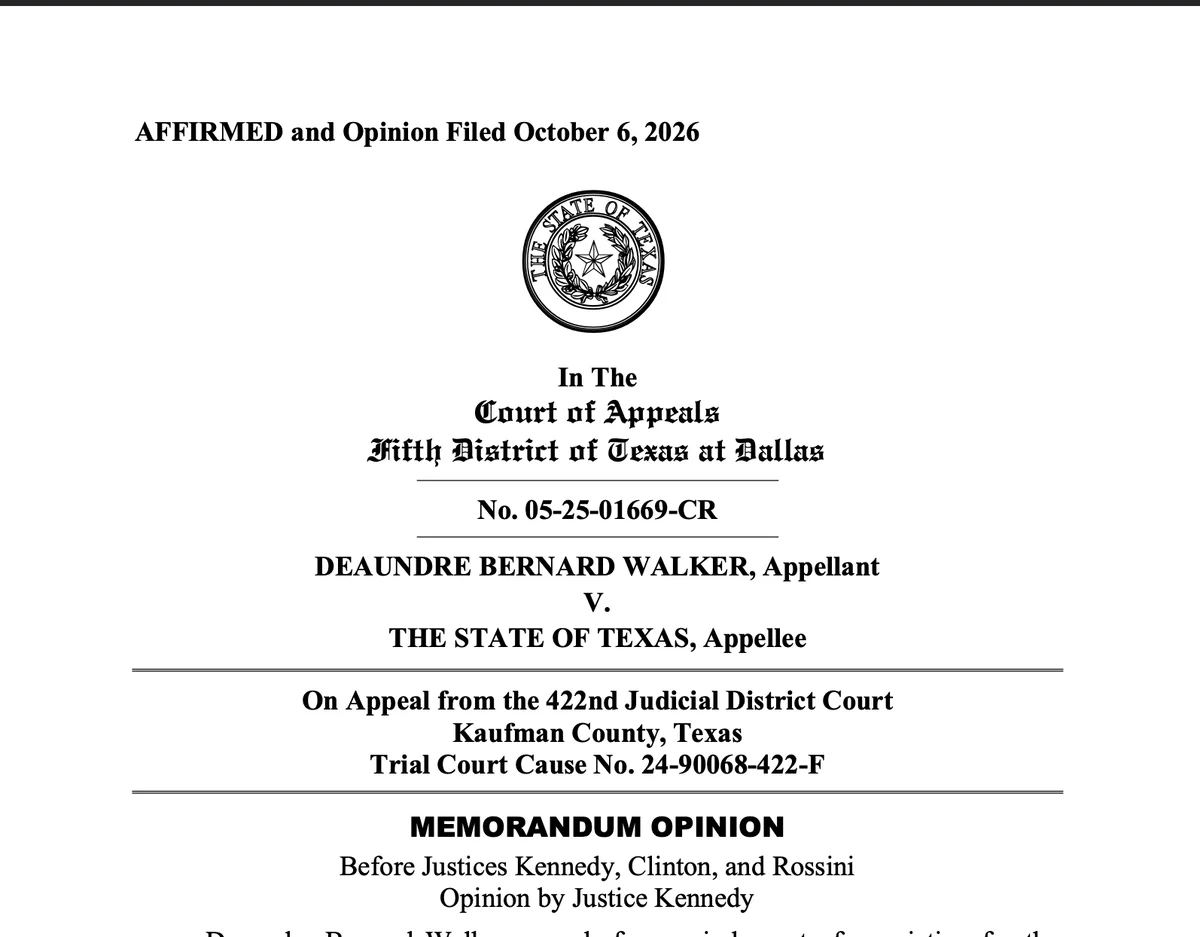
In a memorandum opinion issued Tuesday, July 21, the court rejected Luis Velazquez-Rosa’s appeal, which argued that prosecutors failed to sufficiently prove he was the driver of the black sedan involved in the January 21, 2024, crash. A Kaufman County jury previously convicted Velazquez-Rosa of driving while intoxicated (DWI), third or more offense, resulting in a five-year sentence in the Texas Department of Criminal Justice and a $7,500 fine.
The appeal did not contest Velazquez-Rosa’s intoxication at the time of the crash, nor did it challenge the evidence regarding his two prior DWI convictions. The sole focus of the appellate review was whether the evidence established his role as the driver.
Witnesses observed driver flee the scene
The incident occurred during a night of heavy rain on a narrow, two-lane stretch of U.S. Highway 175. According to trial testimony summarized by the court, a black sedan aggressively passed another motorist, struck a Chevrolet Silverado, and collided with a guardrail, rendering the sedan’s driver-side door inoperable.
A witness testified that he maintained a visual on the sedan from the moment it passed him until it crashed. He observed one man exit the vehicle through the passenger-side door and climb over the guardrail. Upon checking the vehicle, the witness found no other occupants.
The driver of the Silverado provided similar testimony, stating he saw the sedan’s driver exit through the passenger side and flee the scene. Texas Department of Public Safety Trooper Alejandro Rodriguez later arrived to find the damaged vehicles and observed a "dark silhouette" moving over the edge of the bridge. Emergency responders subsequently located Velazquez-Rosa beneath the structure, roughly 20 feet from the crash site.
Physical evidence confirms intoxication
Law enforcement officers reported that Velazquez-Rosa displayed clear signs of impairment, including the scent of alcohol, bloodshot eyes, slurred speech, and loss of balance. Furthermore, police discovered an 18-pack of Modelo beer on the passenger-side floorboard—a space that officers noted would have been occupied by a passenger’s feet.
Though Velazquez-Rosa initially claimed he was alone, he later suggested an unidentified "homeboy" had been driving. However, officers observed a diagonal red mark across his chest consistent with a driver-side seat belt impact. Following a warrant-authorized blood draw, testing revealed an alcohol concentration of 0.264—more than triple the legal limit of 0.08.
Judicial standard for sufficiency of evidence
In its ruling, the appellate panel noted that their role is not to re-try the case, but to determine whether a rational jury, viewing the evidence in the light most favorable to the verdict, could have found every element of the offense proven beyond a reasonable doubt.
Pointing to the continuous eyewitness account, the absence of other occupants, and the physical evidence found on the defendant, the court concluded that the conviction was sound. “The evidence supports the jury’s conclusion that Velazquez-Rosa was driving the black sedan at the time of the accident,” the opinion stated.
Robert Guest, a Forney DWI defense lawyer with Guest & Gray, noted that sufficiency appeals are held to a high standard.
“A sufficiency appeal is very hard for Defendants to win in Texas. This type of appeal is not a second trial. The defense must show more than issues with the evidence or problems with the State’s case. The defense must show that no rational jury could have found the defendant guilty. Asking that a result only be rational is an exceptionally low standard. So even if the State wins a sufficiency of the evidence appeal it doest not mean the case was free from evidentiary issues. It just means the court did not find the jury to be crazy when they said guilty."
Under the Texas Penal Code, driving while intoxicated is elevated to a third-degree felony when a defendant has two prior qualifying intoxication-related convictions. With the appellate court overruling his sole point of error, Velazquez-Rosa’s conviction stands.