Appeals Court Affirms 45-Year Sentence for Combine Woman in Fatal 2023 Shooting
DALLAS — A Texas appellate court has upheld the conviction and 45-year prison sentence of a Combine woman found guilty in the June 2023 fatal shooting of her live-in boyfriend.
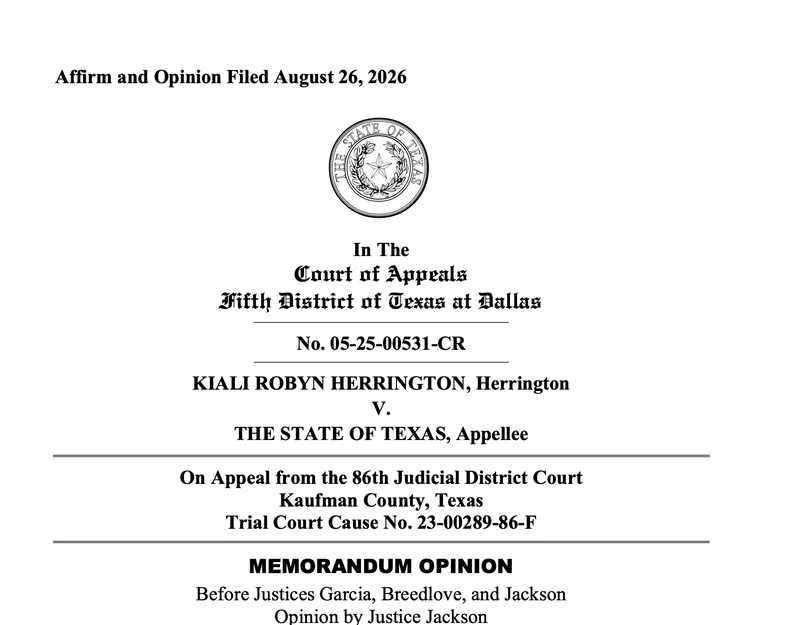
In a 39-page memorandum opinion issued Wednesday, the Fifth Court of Appeals in Dallas affirmed the first-degree aggravated assault conviction of Kiali Robyn Herrington. The three-judge panel systematically rejected nine appellate points raised by the defense, including claims that the state failed to disprove self-defense, that her trial counsel was ineffective, and that prosecutors withheld critical evidence.
A Volatile Night on Davison Road
The case centers on the early morning hours of June 7, 2023, at a mobile home on Davison Road, south of Combine. At approximately 12:40 a.m., Herrington contacted 911 in a state of distress. During the 15-minute emergency call, she informed dispatchers that she and her 38-year-old fiancé, Brandon Clark, had engaged in a physical altercation and that she had "shot him in the arm" by mistake. While she alleged that Clark had been violent and threatened her life, she initially resisted instructions to leave the scene to meet responding officers.
Upon arrival, Kaufman County Sheriff's deputies discovered Clark on the kitchen floor with a fatal gunshot wound to his upper right shoulder. The kitchen was in disarray, and a window air-conditioning unit had been dislodged, lying on the ground outside. Despite 40 minutes of on-scene CPR and an emergency medical airlift, Clark succumbed to internal injuries caused by a bullet that pierced his lung and heart.
Autopsy results indicated that Clark, who stood 6 feet tall and weighed 277 pounds, had methamphetamine in his system. Investigators also discovered a glass drug pipe and a baggie containing a crystal substance on his person. Forensic analysis of the gunshot wound revealed gunpowder stippling, suggesting the firearm was discharged from a distance of one to three feet. The trajectory of the bullet was consistent with a downward angle, potentially indicating that the shooter was at a higher elevation or that the victim was in the process of rising from the floor.
Herrington was initially booked on a manslaughter charge and subsequently indicted for murder. She was ultimately convicted of first-degree aggravated assault with a deadly weapon involving a dating partner; the murder charge was dismissed following the conviction.
Dissecting the Self-Defense Claim
Throughout the trial, Herrington maintained she acted in self-defense. She testified that an irate Clark chased her into the home after a dispute, kicked the front door, removed the back window unit, and grabbed her through the opening. She claimed she fired a warning shot, experienced a weapon malfunction, and fired a second time as Clark lunged at her from a kneeling position.
The Court of Appeals noted that the jury had sufficient evidence to discredit this account:
Physical Inconsistencies: Law enforcement noted the window sill was nearly five feet high, making it improbable for the 280-pound Clark to enter without disturbing items on an adjacent table.
Contradictory Statements: Herrington’s narrative evolved; she initially told police Clark threw the air conditioner out the back door, and later failed to mention the alleged gun jam during her police interview.
Absence of Forensic Evidence: Despite her claim of performing CPR, deputies observed no blood on Herrington's hands or clothing.
History of Conflict: Digital evidence showed Herrington had previously sent Clark a photo of herself pointing a gun at him, and a witness testified to a prior incident where Herrington allegedly shot at him.
"Even if the jury believed Clark did come through the window... it could have found it was not reasonable for Herrington to believe that the use of deadly force was immediately necessary," wrote Justice Earl N. Jackson, noting that Clark was unarmed.
Attorney Disclosures and Discovery Failures
Herrington’s appeal heavily featured claims of ineffective assistance of counsel. During a three-day post-trial evidentiary hearing, defense counsel admitted under oath that he did not personally review every piece of discovery, citing the sheer volume of the case files, though he noted that members of his legal team had conducted the review.
While Herrington claimed a total breakdown in communication, records presented at the hearing demonstrated that the defense team logged 72 formal meetings regarding her file. Defense counsel testified that he held numerous in-person meetings with her, and Herrington herself acknowledged visiting the office at least ten times.
The appellate court concluded that the defense’s trial strategy—including specific decisions regarding objections—remained within the scope of reasonable professional judgment.
Unopened X-Ray and Ruling
Finally, the court addressed a claim regarding a failure to disclose an X-ray performed on Herrington’s elbow by jail medical staff shortly after her arrest. Because the resulting radiology report showed no acute fractures or abnormalities, the court ruled that the non-disclosure did not prejudice the outcome of the trial.
Justices Teresa Garcia and Maricela Breedlove joined Justice Jackson in affirming the judgment of the 86th Judicial District Court.