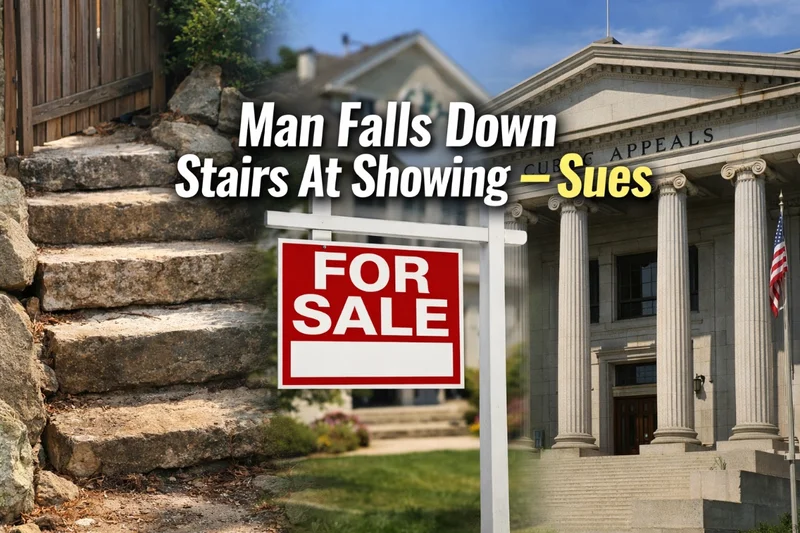
It started the way a lot of real estate stories do: a prospective buyer walking through a home, picturing the future.
It ended with a fall, multiple surgeries—and a lawsuit that went all the way to the Court of Appeals.
Gerard “Gary” Born was touring a home in Rockwall County in April 2022 when he stepped out of the backyard through a gate and fell down a short set of stone steps. He later claimed the steps were steep, unmarked, and dangerous. The injuries were serious. The lawsuit followed.
But the courts saw it differently.
Are Stairs Legally Dangerous?
That’s the heart of this case—and the answer may surprise people.
In Texas, the law doesn’t ask whether something can be dangerous. Plenty of everyday things are. Instead, courts ask a more precise question:
Was the danger hidden—or was it obvious?
Because if it’s obvious, the law usually says: that’s on you.
Born argued the steps were effectively concealed and created an unreasonable risk. He said there were no warnings and that the elevation change wasn’t apparent.
The homeowners responded with photos and a straightforward argument: nothing about the steps was unusual. No defects. No prior incidents. Just a normal set of stairs leading from a backyard to a driveway.
Why the Court Ruled Against Him
The trial court dismissed the case. Born appealed. The Dallas Court of Appeals reviewed the evidence and reached the same conclusion.
The court found:
The steps were ordinary and in good condition.
The area was visible when exiting the gate.
There was no evidence of prior injuries.
And most importantly, Born failed to present enough evidence that the condition was anything other than open and obvious.
Under Texas law, that finding is decisive.
Property owners must warn about hidden dangers. But they are not required to warn about conditions a reasonable person can see and avoid.
Even if someone gets seriously hurt.
What the Court Really Said About Stairs
For lawyers, the opinion reads like a reaffirmation of a long-settled rule: not every hazard is legally actionable.
Scott Gray, a partner at Guest and Gray Law Firm, says the court didn’t create new law—it applied existing principles exactly as expected.
“The court is reinforcing a basic rule in Texas premises liability law—property owners are not required to warn you about conditions that are open and obvious,” Gray said. “Stairs, even steep ones, are generally considered everyday conditions. If a reasonable person can see and appreciate the risk, the law puts the responsibility on the person walking, not the property owner.”
Gray says that’s why cases like this are difficult for plaintiffs, even when the injuries are serious.
“The takeaway is simple: stairs are not legally dangerous just because someone falls,” Gray said. “To win, you have to show something hidden, defective, or deceptive—and that just wasn’t there in this case.”
The Hard Truth About Premises Liability
This is where the law can feel harsh.
Someone got seriously hurt. That part isn’t disputed.
But Texas courts are clear: injury alone does not equal liability.
To win a premises liability case, a plaintiff must show the property owner failed to address a danger that was not reasonably apparent.
And stairs—almost by definition—usually don’t meet that standard.
Courts across Texas have repeatedly treated stairs as ordinary conditions. Even when they are steep. Even when lighting isn’t perfect. Even when someone gets hurt.
If they are visible, they are typically considered open and obvious.
The Bottom Line
Born’s case didn’t fail because his injuries weren’t real. It failed because the law draws a clear line—and that line is visibility.
If a danger is right in front of you, Texas law expects you to recognize it.
Even if you don’t.
And in this case, three backyard steps were enough to end a lawsuit before it ever reached a jury.
Learn More
Learn more about premises liability defense at Guest and Gray Law Firm
Read about the “open and obvious” doctrine in Austin v. Kroger Texas, L.P.
Review Texas no-evidence summary judgment rules under Texas Rule of Civil Procedure 166a(i)
Browse opinions from the Fifth Court of Appeals of Texas (Dallas)
Public overview of Texas premises liability law from the State Bar of Texas