Forney, TX- If you have ever looked at a map around Forney and wondered why some nearby land is not really “Forney” at all, the answer goes back more than 50 years and starts with Lake Ray Hubbard.
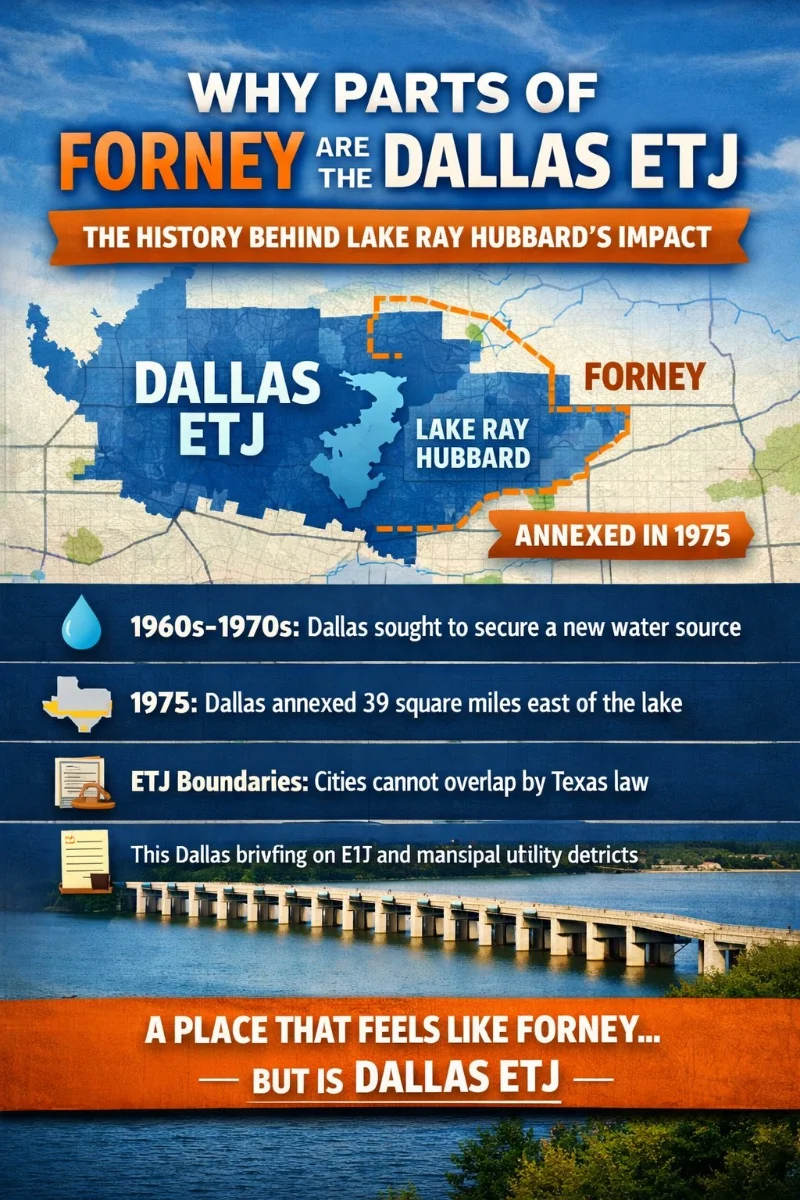
A lot of land people think of as part of the Forney area is actually in Dallas’ extraterritorial jurisdiction, or ETJ. An ETJ is land outside a city’s limits where that city still has certain legal authority over future growth and development.
That is the key to understanding the map east of Dallas.
Dallas’ reach into this area did not begin because of modern suburban growth. It began because Dallas wanted access to a major future water source. In 1963, Dallas annexed a strip of land between Mesquite and Garland to reach the site of a proposed new lake. In the late 1960s and early 1970s, Dallas negotiated with nearby cities over how the lake area would be developed.
Then came the major expansion.
In 1975, Dallas annexed about 39 square miles for the development of Lake Ray Hubbard. That move expanded Dallas’ ETJ five miles into unincorporated parts of Rockwall and Kaufman counties. That meant Dallas secured legal influence over future development in a large area long before many people thought of it as part of greater Forney.
The lake project itself was a major regional undertaking. Construction on Lake Ray Hubbard began in the 1960s as Dallas worked to secure a long-term water supply. That infrastructure decision ended up shaping not just the shoreline, but the legal map far beyond it.
That history still matters today.
When residents see neighborhoods, roads, and developments that feel tied to Forney, it is easy to assume the land must be under Forney’s control. But ETJ lines do not follow what feels local. They follow legal boundaries, and those boundaries were shaped decades ago by Dallas’ annexation decisions tied to the lake.
That is why some land that looks and feels like Forney is still, on paper, in Dallas territory.
In plain English, Dallas got there first. Because Texas law does not allow overlapping ETJs, land that fell into Dallas’ ETJ could not simply become Forney ETJ later unless the boundaries were changed.
So the strange-looking map around Forney is not a mistake. It is the result of a decades-old decision tied to Lake Ray Hubbard, Dallas water planning, and the legal rules governing city growth in Texas.
Learn More
Chapter 42 of the Texas Local Government Code lays out the Texas law governing municipal extraterritorial jurisdiction.
This Dallas city briefing on ETJ and municipal utility districts discusses Dallas’ historical annexation tied to Lake Ray Hubbard and the expansion of its ETJ into parts of Kaufman and Rockwall counties.
This Dallas briefing on ETJ boundaries near Forney provides more detail on the boundary history and the relationship between Dallas ETJ and surrounding cities.
This Dallas City Council resolution shows how Dallas continued to deal with property in Kaufman County that remained inside Dallas’ ETJ.
The Texas State Historical Association entry on Ray Hubbard Lake provides historical context on the creation of the lake and why it mattered to Dallas.