\Here is the new publication-ready story with the links added naturally.
A Detective Called and Wants “Your Side of the Story.” Here’s Why You Should Be Careful.
When a local detective calls your cell phone out of the blue, your stomach drops.
Maybe the call is from the Forney Police Department, the Kaufman County Sheriff’s Office, or another local agency. The detective sounds polite. They say they are investigating an allegation—an assault, a domestic dispute, a driving incident, or something that allegedly happened between you and another person. They tell you they just want to hear “your side of the story” before deciding what to do next.
That sounds reasonable.
It may also be the most dangerous conversation you have all year.
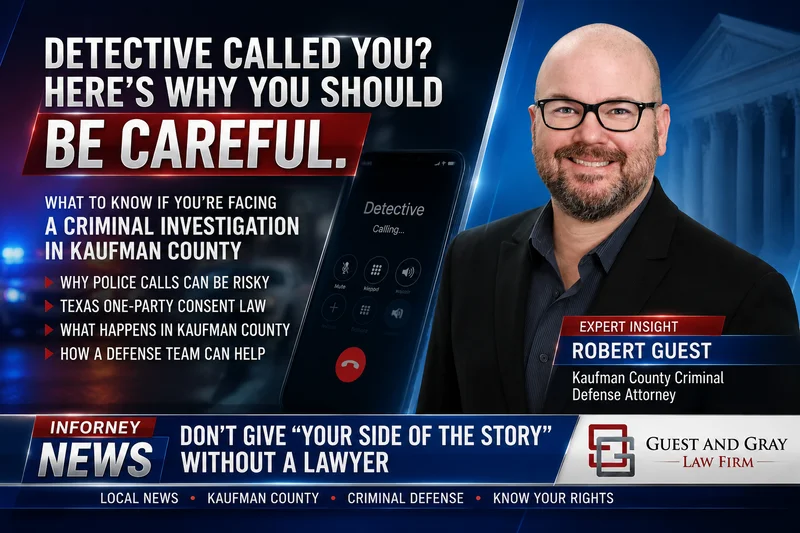
We sat down with veteran Kaufman County criminal defense attorney Robert Guest, co-founder of Guest & Gray Law Firm, to discuss how these investigations really work, why the advice to “stay quiet” is often legally sound, and what happens behind the scenes once a criminal allegation reaches the Kaufman County court system.
The Phone Call You Didn’t See Coming
InForney: Robert, this situation happens more often than people realize. Someone gets a call from a detective saying an ex-partner, acquaintance, neighbor, or witness made an accusation. The person’s first instinct is to explain what happened and clear their name. Why is that usually a mistake?
Robert Guest: Because your instincts are working against you.
When a detective calls you during a criminal investigation, they are not simply acting as a neutral referee. They are gathering evidence. They may already have a statement from the accuser. They may have text messages, photos, 911 audio, body-camera footage, or witness statements. What they usually do not have yet is your voice explaining, minimizing, apologizing, guessing, or filling in blanks.
That is what they are trying to get.
People think, “If I can just explain this, they’ll understand.” But in a criminal investigation, your explanation can become evidence. A small inconsistency can be treated like a lie. A vague apology can be framed as an admission. A detail you think helps you may give the police the missing piece they needed for probable cause.
You are probably not going to talk your way out of an arrest. You may talk your way into one.
The safest response is simple: be polite, do not argue, do not explain, and do not answer questions. Tell the detective you will not make a statement without legal guidance, then end the call and contact a Kaufman County criminal defense lawyer immediately.
“I Just Want to Apologize” Can Become Evidence
InForney: In many local cases—domestic assault allegations, family-violence accusations, harassment claims, or even disputed DWI-related incidents—text messages and phone calls can play a major role. What should people know about communicating with the person who made the accusation?
Robert Guest: Assume every word is being saved, recorded, screenshotted, and handed to law enforcement.
That includes texts, calls, voicemails, Instagram messages, Facebook messages, emails, shared-location data, and anything you send through a third party. If an accuser contacts you after police are involved, the safest assumption is that the conversation may be recorded or monitored.
This is especially important in Texas because Texas is generally a one-party consent state. That means a person who is part of a conversation can usually record it without telling the other person. So if an ex-girlfriend, spouse, roommate, or acquaintance calls you and says, “Why did you do that?” or “Just admit what happened,” that call may be recorded.
And even when you think you are being careful, normal human language can be twisted.
A text that says, “I’m sorry I made you feel that way,” may be presented as consciousness of guilt. A message that says, “I didn’t mean for things to get out of hand,” may be treated like an admission. A late-night call, even if you are trying to calm things down, may violate a bond condition or protective order if one has been put in place.
Once a criminal investigation begins, stop communicating with the accuser unless your attorney specifically tells you otherwise.
How Criminal Allegations Move Through Kaufman County
InForney: Once an accusation is made, how does the process usually move forward in Kaufman County?
Robert Guest: It can move very fast at the beginning, then slow down dramatically.
In some cases, police make an arrest at the scene. In other cases, officers investigate, gather statements, and seek an arrest warrant from a magistrate. Sometimes a case is sent to the Kaufman County Criminal District Attorney’s Office as a referral without an immediate arrest.
If a warrant is issued or an arrest happens, the person then has to deal with booking, bail, bond conditions, and sometimes strict restrictions on contact, travel, alcohol use, firearms, or where they can go. In family-violence cases, no-contact provisions and emergency protective orders can appear quickly and can have serious consequences if violated.
From there, the case may be reviewed by the District Attorney’s Office. That review can lead to a formal charge, a request for more investigation, a rejection, a plea offer, or eventually trial preparation. Depending on the allegation, the charge may arise under the Texas Penal Code, the Texas Transportation Code, or another Texas criminal statute.
The important thing to understand is that the early stage matters. What you say before you have a lawyer can shape the entire case.
The Prosecutor Assigned to the Case Matters
InForney: You have handled many cases in Kaufman County. How much does the assigned prosecutor matter?
Robert Guest: It matters a lot.
Some prosecutors take a hard line even when the evidence is thin. Others are more willing to look carefully at witness credibility, motive, missing evidence, and whether the state can actually prove the case beyond a reasonable doubt.
You do not always know at the beginning what kind of prosecutor will be assigned. That is why the defense has to prepare the case seriously from day one. You cannot assume the case will “go away” just because the accusation is weak or unfair.
Weak cases still get filed. Weak cases still cause arrests. Weak cases still damage jobs, families, reputations, and futures.
What a Defense Team Does That Police Usually Will Not
InForney: What does a private defense team do that the police do not?
Robert Guest: The police are usually focused on evidence that supports the allegation. A defense team has to look for the evidence that tells the full story.
That may mean preserving text messages, finding deleted or overlooked communications, interviewing independent witnesses, locating surveillance video, reviewing 911 calls and body-camera footage, examining timelines, and investigating the accuser’s credibility, motive, and prior inconsistent statements.
In assault and family-violence cases, context matters. The relationship history matters. Who contacted whom first matters. Injuries, photos, timing, intoxication, jealousy, retaliation, custody disputes, breakups, and financial pressure can all matter.
We do not just wait for the state to hand over discovery and hope for the best. We investigate. We test the state’s story. We look for what is missing.
If we can show that an allegation was exaggerated, retaliatory, inconsistent, or unsupported by the evidence, that can change the direction of the case.
What to Do If You Are Under Investigation
If a detective contacts you about a criminal allegation, do not panic—but do not improvise.
1. Do Not Give a Statement
You can be polite without being cooperative. Say: “I am not making any statement without an attorney.” Then stop talking.
2. Do Not Contact the Accuser
Do not text, call, message, apologize, explain, argue, or ask mutual friends to intervene. Anything you say may become evidence. If bond conditions or protective orders exist, contact may also create new criminal problems.
3. Preserve Your Data
Do not delete messages, call logs, photos, social media posts, location history, or emails. Deleting evidence can make things worse. Your attorney needs the full context, not a cleaned-up version.
4. Write Down What You Remember
Privately make notes for your lawyer while the timeline is fresh. Include dates, times, names, locations, witnesses, screenshots, and anything that may help reconstruct what happened.
5. Get Counsel Between You and the Police
The goal is not to hide. The goal is to avoid accidentally giving the state evidence while your defense team investigates the facts.
What Happens at Each Stage of the Case
Stage of the Case
What the State May Be Doing
What the Defense Should Be Doing
Investigation
Taking statements, collecting texts, reviewing photos, trying to interview you, and deciding whether to seek a warrant or file a case
Advising you not to speak, preserving digital evidence, identifying witnesses, monitoring for warrants, and preparing an early defense strategy
Arrest and Bond
Booking you, setting bail, requesting bond conditions, and imposing contact restrictions
Working to secure release, reviewing bond terms, challenging excessive or unnecessary restrictions, and preventing accidental violations
Case Filing and Discovery
Preparing formal charges, producing police reports, videos, recordings, and other evidence
Reviewing discovery, finding gaps, comparing statements, investigating credibility, and gathering defense evidence
Negotiation and Litigation
Offering a plea bargain, preparing for hearings, or pushing toward trial
Seeking dismissal, reduction, diversion, suppression of evidence, favorable negotiation, or trial when necessary
Trial Preparation
Organizing witnesses and evidence to prove guilt beyond a reasonable doubt
Testing every element of the state’s case, preparing cross-examination, presenting defense evidence, and protecting the client’s future
How Long Does This Take?
InForney: For someone facing an investigation or criminal charge in Kaufman County, what should they expect from the timeline?
Robert Guest: They should expect a marathon, not a sprint.
People want an immediate answer: “Will this be dismissed?” “Am I going to jail?” “Will I lose my job?” Those are understandable questions, but criminal cases often take time.
A serious misdemeanor or felony investigation in Kaufman County can take months. Once filed, a case may take a year or more to fully resolve, depending on the charge, the evidence, the court’s docket, the prosecutor, and whether the case is negotiated, dismissed, reduced, or tried to a jury.
The best approach is to focus on the next step. Do not try to solve the entire case in your head on day one. Hire the right team, preserve your evidence, follow your lawyer’s instructions, and do not make the situation worse.
Final Advice for Kaufman County Residents
InForney: Any final advice for someone dealing with this kind of legal pressure?
Robert Guest: Do not fight the system alone, and do not let fear make your decisions for you.
A detective’s phone call can feel informal, but it may be the beginning of a criminal case. A text message can feel harmless, but it may become Exhibit A. A quick apology can feel human, but it may be argued as a confession.
Your job is not to explain everything to the police. Your job is to protect yourself, preserve the evidence, and get a defense team working before the state’s version of the story becomes the only version anyone hears.
When your future is on the line, silence is not rude. It is smart.
If you have been contacted by law enforcement in Forney, Kaufman, Terrell, Crandall, or anywhere in Kaufman County, contact Guest & Gray Law Firm before making a statement.