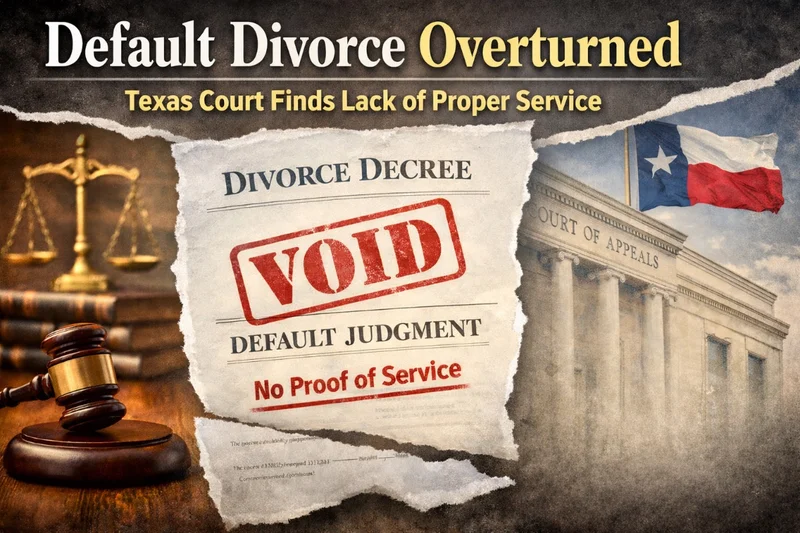
DALLAS, TX- A Texas appeals court has thrown out a default divorce decree after finding the record did not show proper service on the husband, meaning the trial court never acquired personal jurisdiction over him. In an opinion issued April 8, 2026, the Fifth Court of Appeals in Dallas reversed the decree and remanded the case for further proceedings.
The case began after the wife filed for divorce in 2022. A default final decree of divorce was signed on November 29, 2022, by submission. According to the opinion, the husband later said he did not learn about the decree until July 2024, then filed a bill of review challenging it. The appeals court agreed that the record could not support the default judgment because it did not contain a return of service showing compliance with Texas procedure.
That missing paperwork was not a small technical problem. The court explained that Texas law requires strict compliance with service rules before a default judgment can stand. It also stressed that no-answer default judgments are disfavored, that courts do not presume service was valid, and that the party seeking service has the burden to make sure it was properly completed and reflected in the record.
In this case, the appellate court said the record contained no return of service at all. Without proof of service on file, the trial court was not allowed to render a default judgment. Because the record did not establish proper service, the trial court lacked personal jurisdiction over the husband, making the divorce decree void.
“Texas courts disfavor default judgments, and service issues are one of the main reasons they can be overturned,” said Robert Guest of Guest & Gray. “Due process is not a technicality. It is the foundation of a valid judgment.”
In practical terms, the ruling does not mean the divorce can never go forward. It means this divorce could not be finalized by default on this record. The case now returns to the trial court, where it can proceed with proper notice and an opportunity for both sides to be heard.
The opinion also rejected the argument that later testimony could fix the problem. The wife argued on appeal that testimony from the bill-of-review hearing showed a process server came to the house and served the husband. But the court said that was not enough. The burden does not shift to the husband to disprove service until the party seeking the default first proves service was completed the way Texas law requires. Here, the court said that never happened.
“This opinion is a reminder that judges do not just look at whether someone says service happened,” Guest said. “They look at whether the record proves it happened the way Texas law requires. If the paperwork is missing or defective, a default judgment can unravel years later.”
For families, the case is a warning about assuming a default divorce is simple. A spouse’s failure to answer can open the door to a default judgment, but only if the filing party has strictly followed the rules on citation and service. If that foundation is missing, what appears finished can be reopened later.
“When a divorce involves property, children, support, or long-term financial consequences, getting the procedure right matters just as much as arguing the facts,” Guest said. “A shortcut at the front end can become a major problem at the back end.”
Guest & Gray’s family-law pages explain several of the issues that often come up in divorce cases, including how divorce is filed, no-fault divorce, uncontested divorce, and common family-law questions in Texas. The firm’s family law page includes a Texas family-law FAQ, and its divorce pages discuss legal options and process issues that can mattewhen a case becomes contested or procedurally complicated.
The bottom line from the Dallas court was narrow but important: before a Texas court can enter a valid default divorce, the record must show strict compliance with the rules governing service of process. If it does not, the judgment may not survive direct attack.
Learn More
Read Guest & Gray’s Family Law page for an overview of Texas family-law issues, including divorce and related questions.
Review the firm’s Divorce page for information on the Texas divorce process and legal options.
See Guest & Gray’s Uncontested Divorce page for background on agreed divorce cases and how they differ from other divorce proceedings.
Read the No-Fault Divorce page for a breakdown of insupportability and how no-fault divorce works in Texas.
Browse the Guest & Gray Guides page for additional family-law and divorce resources.