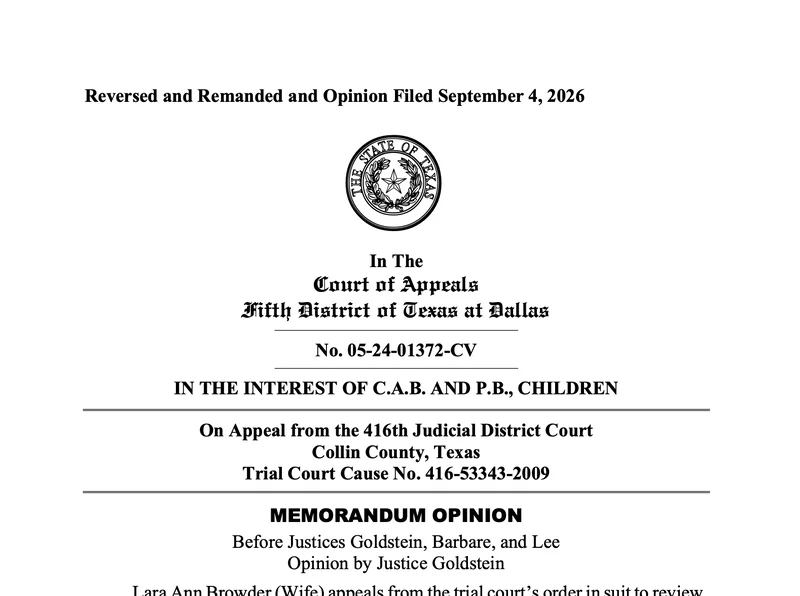
DALLAS — When it comes to divorce settlements in Texas, the distinction between court-ordered alimony and private contractual agreements is more than just semantics—it is a matter of long-term legal liability. A recent ruling by the Dallas Court of Appeals in In the Interest of C.A.B. and P.B., Children (No. 05-24-01372-CV) has brought this critical distinction to the forefront.
Justice Bonnie Goldstein delivered the court’s opinion, which reversed a Collin County trial court order that had prematurely terminated Larry Dwane Browder’s monthly support obligations to his ex-wife, Lara Ann Browder. The decision serves as a stern reminder that parties who voluntarily sign agreements exceeding statutory requirements may find themselves bound by those terms long after the standard legal limits have expired.
The Background: A Contractual Agreement
The dispute stems from the couple’s 2010 divorce decree, which mandated that Larry pay Lara $2,500 per month until she remarried or cohabitated. Notably, the decree was the product of an informal settlement process and explicitly stated that its terms were "enforceable as a contract." Furthermore, the agreement included non-statutory provisions, such as requiring Larry to secure the payments via a life insurance policy and binding his estate to the financial obligation.
The Legal Dispute
In early 2024, Larry sought to terminate his support obligations, arguing that the payments fell under Chapter 8 of the Texas Family Code. At the time of the 2010 divorce, Chapter 8 carried a three-year statutory limit on spousal support. The trial court initially sided with Larry, ruling that the support was statutory and terminating it retroactively.
However, the Fifth Court of Appeals disagreed. The appellate court held that because the decree incorporated explicit contractual language and transcended the requirements of the Family Code, the support could not be categorized merely as a court-mandated Chapter 8 order. Instead, it was a private, binding contract.
Expert Insight: The Danger of Poor Drafting
"If you sign an agreement to pay spousal support beyond what the Family Code allows, the court may enforce those terms as a binding contract," said Robert Guest, founding partner at Guest & Gray. "This ruling highlights how critical precise drafting is during a divorce, as contractual agreements carry long-term legal power that courts cannot simply rewrite later. The more 'do-it-yourself' or AI-generated divorce decrees we see, the more this will become a significant problem for litigants."
Next Steps
Following the reversal, the appellate court remanded the case back to the trial court to address Larry’s alternative requests regarding the potential modification or cessation of income withholding.
Meet Robert Guest, criminal defense attorney and founding partner
This video introduces Robert Guest and highlights his expertise as a founding partner at Guest & Gray.